


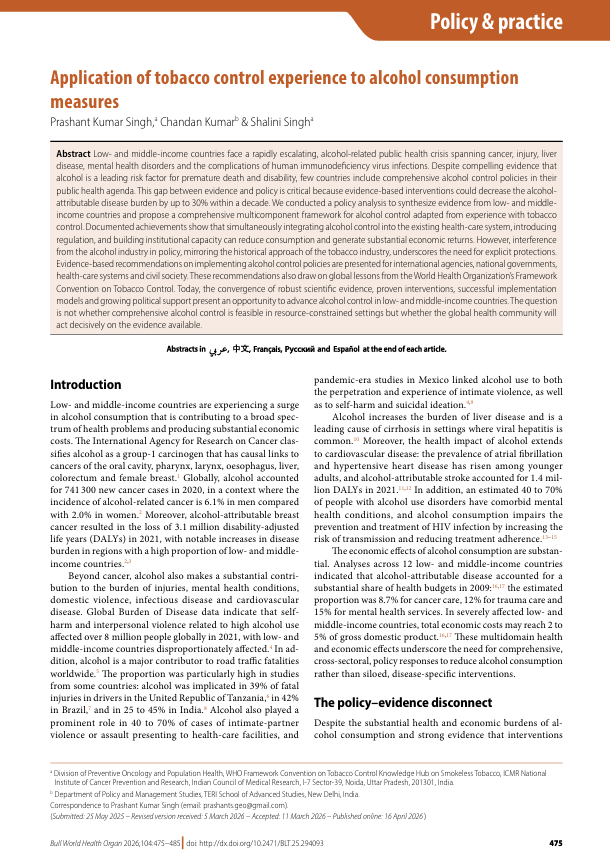
In this Policy and Practice article published in the Bulletin of the World Health Organization, the authors highlighted an opportunity to advance alcohol control in low- and middle-income countries. This opportunity is marked by converging definitive scientific evidence, proven interventions, implementation models, and growing political will. The authors noted how political will, civil society engagement, and international cooperation can build on the roadmap laid out by the success of the WHO Framework Convention on Tobacco Control.
Drawing on lessons from tobacco control and the WHO Framework Convention on Tobacco Control (FCTC), the paper proposes a three-component framework for alcohol control: integration of alcohol prevention and treatment into existing health systems; implementation of comprehensive regulatory policies such as taxation, marketing restrictions, availability controls, and drink-driving measures; and development of institutional capacity through dedicated funding, multisectoral governance, and safeguards against industry interference.
The authors presented evidence from policy implementation in low- and middle-income countries like Thailand, Sri Lanka, India, South Africa, Malawi, Kenya, and the Russian Federation. The authors also suggested actions for different policy actors, including global public health organizations, national governments, health care systems and professional organisations, and civil society and community organisations.
What does this mean for FORUT’s partners?
The article strongly reinforces FORUT’s advocacy approach. First, it validates the importance of promoting the WHO SAFER package as a comprehensive policy package rather than advancing isolated measures. Second, it highlights the critical role of civil society in building coalitions, countering industry misinformation, monitoring policy implementation, and holding governments accountable. Third, the paper provides further evidence of alcohol industry interference and the need for conflict-of-interest safeguards in policymaking. Finally, the documented successes from Thailand, Sri Lanka, Malawi, India, and South Africa offer practical examples that FORUT partners can use to demonstrate that effective alcohol control is feasible, cost-effective, and beneficial for health, gender equality, child protection, and sustainable development.
Recommended citation:
Singh PK, Kumar, C, & Singh S. (2026). Application of tobacco control experience to alcohol consumption measures. Bulletin of the World Health Organization 104:475-485. http://dx.doi.org/10.2471/BLT.25.294093