


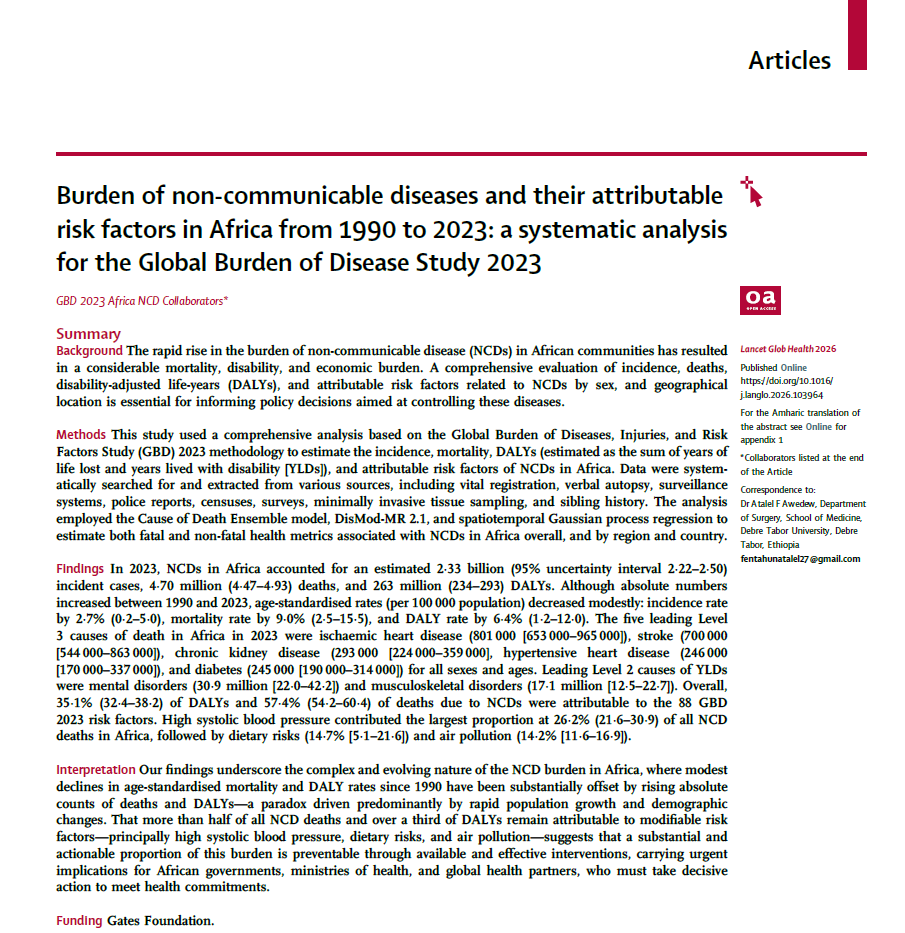
This Global Burden of Disease Study covers all 54 African countries using GBD 2023 data and includes data on behavioural, metabolic, and social risk factors relevant to FORUT partners in the African region.
Key overall findings relevant for FORUT partners in the African region:
- In 2023, NCDs accounted for 4.70 million deaths and 263 million DALYs in Africa, representing 44.9% of all deaths and 38.3% of all DALYs.
- The absolute burden has grown dramatically since 1990: NCD deaths increased 122.2% and DALYs 118.0%, largely in the context of population growth and demographic change.
- Sub-Saharan Africa experienced particularly large increases in absolute burden: deaths rose 133.5% and DALYs 133.0% between 1990 and 2023.
- The authors specifically identify insufficient alcohol-control policies as one factor relevant to Africa’s high burden and call for restrictive alcohol-control policies with a multisectoral response.
- This reinforces the need to see NCDs not simply as a clinical health problem, but as a development challenge connected to poverty, nutrition, gender, mental health, alcohol and substance use, and access to services.
Alcohol and drugs:
- High alcohol use accounted for an estimated 82,600 NCD deaths and 3.87 million DALYs in Africa in 2023.
- Alcohol-specific disease outcomes remain significant. Cirrhosis due to alcohol caused about 28,000 deaths, while liver cancer due to alcohol caused about 14,600 deaths in 2023.
- Drug use accounted for about 19,900 NCD deaths and 1.58 million DALYs in 2023.
- Deaths from drug-use disorders increased from approximately 2,400 to 8,500, with opioid-use-disorder deaths reaching about 6,900 in 2023.
- This quantitative evidence strongly supports justification for continued attention to alcohol and drugs as a development issue, and for maintaining alcohol, and drug prevention and policy advocacy in FORUT partners’ programmes.
Mental health:
- Mental health disorders is the leading cause of years lived with disability in Africa, accounting for 30.9 million years lived with disability (YLD), in 2023.
- The burden of mental health disorders has tripled since 1990 and highlights poverty, conflict and trauma alongside structural problems such as insufficient financing, workforce shortages and weak policy prioritisation.
- It calls for mental health to be integrated into universal health coverage, expansion of services, innovative delivery models, increased investment and mobilisation of community voices.
- These findings strongly support community-based, rights-oriented mental health programmes and integration of mental health across FORUT partners’ programmes.
Child rights:
- Sexual violence against children accounted for approximately 3.37 million DALYs, while bullying victimisation accounted for 1.61 million DALYs.
- The age-standardised DALY rate associated with bullying victimisation increased 54.1% between 1990 and 2023.
- Child protection, psychosocial wellbeing and NCD prevention can reinforce one another. Violence and bullying have measurable long-term health consequences, strengthening the case for FORUT partners’ programmes to support safe environments for children and early prevention.
Gender equality and violence against women:
- Intimate partner violence accounted for approximately 1.68 million DALYs in 2023. Its absolute attributable DALY burden increased 278.8% between 1990 and 2023.
- Breast cancer deaths increased from about 25,600 in 1990 to 129,000 in 2023, while cervical cancer deaths increased from approximately 35,200 to 107,000.
- FORUT partners’ gender-responsive programming should continue to link violence prevention, women’s health, psychosocial wellbeing and equitable access to prevention and services.
Livelihood and food security:
- Dietary risks were the second-largest attributable risk factor for NCD deaths in Africa, accounting for an estimated 693,000 deaths, or 14.7% of NCD deaths, and approximately 19.9 million DALYs in 2023, a 130% increase from 1990.
- The authors connect rising dietary risk to a nutritional transition involving greater consumption of processed foods, poor diet quality and limited access to healthy alternatives.
- FORUT partners’ food-security programming needs to consider access to adequate, affordable and healthy food.
What does it mean for FORUT and its partners?
FORUT and its partners should continue to integrate NCD prevention into community development. Alcohol and drug prevention, mental health support, child protection, gender-based violence prevention, and food and livelihood programmes can all reduce important NCD risks. Partners can strengthen community awareness, early identification and referral, while advocating for healthier food environments, effective alcohol policies, mental health services and protection from violence. FORUT partners should continue to focus on women, children and vulnerable households. Programmes should also help collect relevant local data and amplify community voices so that prevention and services respond to people’s lived realities and inequalities.
Recommended citation:
GBD 2023 Africa NCD Collaborators. (2026). Burden of non-communicable diseases and their attributable risk factors in Africa from 1990 to 2023: A systematic analysis for the Global Burden of Disease Study 2023. The Lancet Global Health, 103964. https://doi.org/10.1016/j.langlo.2026.103964