


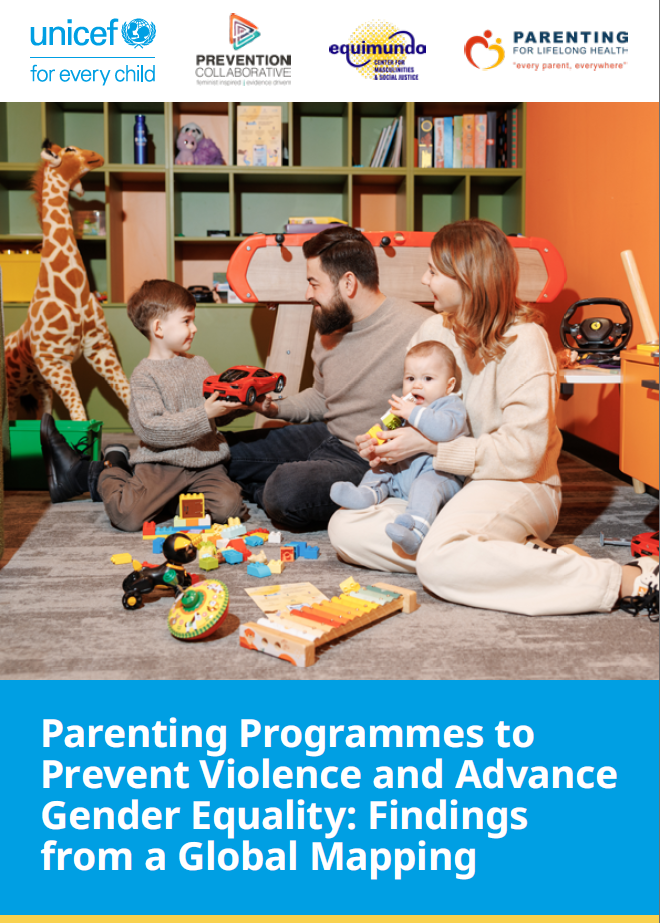
The brief presents findings from a global mapping of 69 parenting programmes across 43 countries, highlighting their role in preventing violence against children (VAC), reducing violence against women (VAW), and promoting gender equality. Parenting programmes are widely implemented—primarily by NGOs and government partnerships—and most focus on strengthening positive parenting, reducing harsh discipline, and improving caregiver–child communication.
While 97% of programmes target VAC, only about half address VAW, and just one-third explicitly tackle both forms of violence, despite evidence that these often co-occur. Gender-transformative approaches—engaging both women and men, challenging harmful gender norms, and promoting shared caregiving—show particular promise in simultaneously reducing IPV and violent discipline. However, most programmes remain at early or partial stages of integrating gender equality.
Programmes vary widely in delivery (in-person groups, hybrid digital models, community mobilisation), with growing use of low-cost digital tools for scale. Evidence generation is uneven: although many programmes document outcomes, fewer have rigorous evaluations of gender-transformative impact. Overall, the mapping concludes that parenting programmes are a powerful entry point to address intersecting forms of violence and advance holistic family well-being, but require stronger integration of gender equality, evidence, and system-level scale-up.
What it means for FORUT and its partners
The findings are highly relevant to FORUT partners implementing family-based interventions. Parenting programmes are confirmed as effective platforms to simultaneously address violence, gender inequality, and mental health—core FORUT programmes. However, many programmes only partially integrate gender-transformative approaches, indicating a need for partners to more explicitly address power relations, masculinity norms, and shared caregiving. The limited focus on both VAC and IPV suggests an opportunity to strengthen integrated violence prevention models. Finally, gaps in policy engagement and rigorous evaluation align with FORUT’s strategic role in scaling evidence-based approaches and strengthening documentation of combined outcomes.
Recommended citation:
UNICEF Office of Strategy and Evidence – Innocenti, Prevention Collaborative, Equimundo, and Parenting For Lifelong Health. (2026). Parenting Programmes to Prevent Violence and Advance Gender Equality. Findings from a Global Mapping. Florence: UNICEF Innocenti