


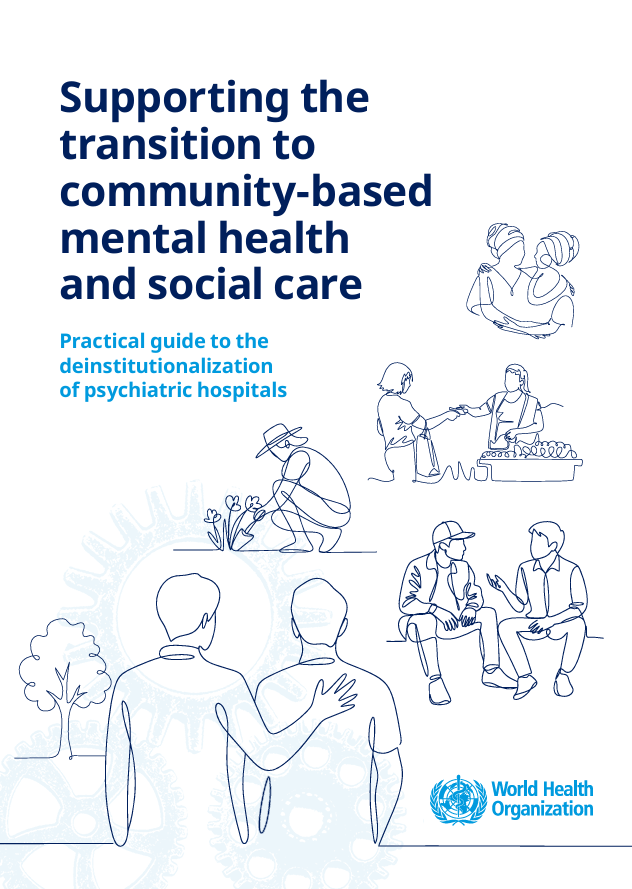
This WHO guide presents deinstitutionalization as a rights-based transformation of mental health systems. It calls for replacing long-term institutional care with coordinated, person-centred community services that promote autonomy, dignity, recovery and social inclusion. Successful transition requires simultaneous investment in community services, housing, social protection, primary healthcare, peer support and livelihoods, alongside gradual hospital downsizing. The guide highlights the need for people with lived experience to participate meaningfully in planning, governance and evaluation. The guide emphasizes the vital role of NGOs in deinstitutionalization, especially in: assessing family and community needs, mapping stakeholders and service gaps, piloting and scaling community-based supports, reaching underserved groups through grassroots approaches, raising awareness of mental health conditions and services, advocating for systemic change and amplifying voices of people with lived experience, providing technical and educational support, and offering interim funding, staff, or infrastructure to address gaps.
What does this mean for FORUT partners?
For FORUT partners, deinstitutionalization can translate to helping children and adults with mental health conditions live safely and participate fully in their communities. FORUT partners’ community programmes can be strengthened to further bolster local mental health support, referral systems, schools, families, peer networks and health services. For children, interventions should protect their right to grow up in a family environment, attend school, be heard in decisions affecting them, and receive appropriate care without discrimination. Partners can design projects that enable them to support families and caregivers rather than shift responsibility for care onto them. More importantly, partners can provide an enabling, supportive environment for children and adults with lived experience to help design community-based mental health and social care services and monitor whether services promote dignity, inclusion, participation, and independence.
Recommended citation:
World Health Organization. (2026). Supporting the transition to community-based mental health and social care: practical guide to the deinstitutionalization of psychiatric hospitals. Geneva: World Health Organization.