


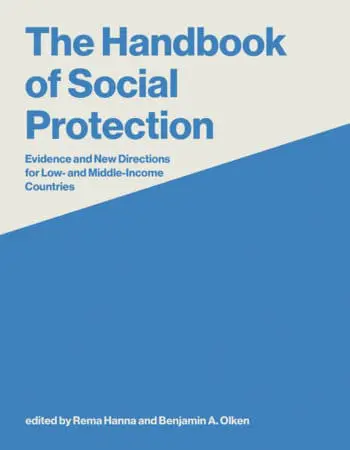
In this Norwegian Agency for Development Cooperation (NORAD)-supported handbook, the editors and contributing authors reviewed research on social protection in low- and middle-income countries, examined lessons from the history of social protection, and covered the design of transfer programs, livelihood programs, and social insurance programs, as well as their broader impacts.
The Handbook of Social Protection offers a comprehensive, evidence‑based assessment of how social protection systems—particularly in low‑ and middle‑income countries (LMICs)—reduce poverty, build resilience, and support inclusive development. Drawing on historical analysis and recent empirical research, it shows that social protection is not a temporary or “auxiliary” policy tool, but a core component of long‑term development trajectories.
What works: Cash transfers and integrated approaches
The strongest evidence in the handbook concerns cash transfer programs, both unconditional (UCTs) and conditional (CCTs). Across LMICs, these programs consistently reduce poverty and food insecurity while improving education, child health, and psychological well‑being. Fears that transfers reduce work effort are largely unsupported; in several contexts, transfers instead enable productive investment in small businesses, farming, and human capital.
For organizations like FORUT, this reinforces the value of rights‑based income support as a foundation for broader social change. Notably, cash transfers show important mental health benefits, including reductions in stress and depression—an underappreciated channel linking economic security to social outcomes such as reduced violence and substance misuse.
Gender equality and social norms
The handbook emphasizes that gender‑sensitive social protection design matters. Programs that transfer resources directly to women tend to strengthen women’s bargaining power, increase health and education investments for children, and, in some settings, reduce intimate partner violence. However, these benefits are not automatic. The evidence highlights the need for complementary measures—such as childcare, financial literacy, and community engagement—to avoid reinforcing existing gender norms.
For FORUT, which often works at the intersection of gender, health, and rights, the implication is clear: social protection can be a platform for gender transformation when deliberately designed to address power imbalances and social norms.
Informality, targeting, and delivery challenges
A central constraint in LMICs is high informality, which limits the use of traditional income‑based targeting and contributory insurance. The handbook reviews alternative approaches—proxy means tests, geographic or categorical targeting, community‑based methods, and public works—each involving trade‑offs between accuracy, inclusion, and fairness. Digital ID systems and mobile payments have improved efficiency and reduced leakage in many contexts, but they also risk excluding marginalized groups lacking documentation or digital access.
This underscores the importance of inclusion‑by‑design, grievance mechanisms, and civil society oversight—areas where NGOs like FORUT can play a critical role as advocates and implementers.
Beyond transfers: Livelihoods, insurance, and shocks
The handbook highlights growing evidence for “graduation” and livelihood programs that combine temporary cash support with assets, skills, and coaching. These integrated approaches show durable gains for ultra‑poor households, especially women. Social insurance—health coverage, pensions, and unemployment protection—remains harder to scale in informal economies but is essential for preventing people from falling back into poverty due to shocks, including illness, conflict, and climate events.
Governance, politics, and fragile contexts
Finally, the handbook stresses that social protection is inherently political. Programs can build trust and social cohesion, but they can also be distorted by patronage or electoral incentives. In fragile and conflict‑affected settings, cash‑based assistance has proven feasible and dignity‑preserving, particularly for refugees, though long‑term impacts require links to services and livelihoods.
The handbook strongly supports FORUT’s strategic emphasis on equity, gender justice, health, and resilience. Social protection—when transparent, inclusive, and gender‑responsive—offers a powerful entry point for addressing poverty, reducing harmful coping strategies, and enabling long‑term social change.
Recommended citation:
Hanna, R., & Olken, B. A. (Eds.). (2026). The Handbook of Social Protection: Evidence and New Directions for Low- and Middle-Income Countries. The MIT Press. https://doi.org/10.7551/mitpress/14927.001.0001